
On October 25, XHEART signed a strategic cooperation agreement with the National New Energy Vehicle Technology Innovation Center (NEV Innovation Center). The two parties will jointly research methods and standards for evaluating large-model chips, with the goal of establishing a framework grounded in real-world applications that can be adopted across the industry.
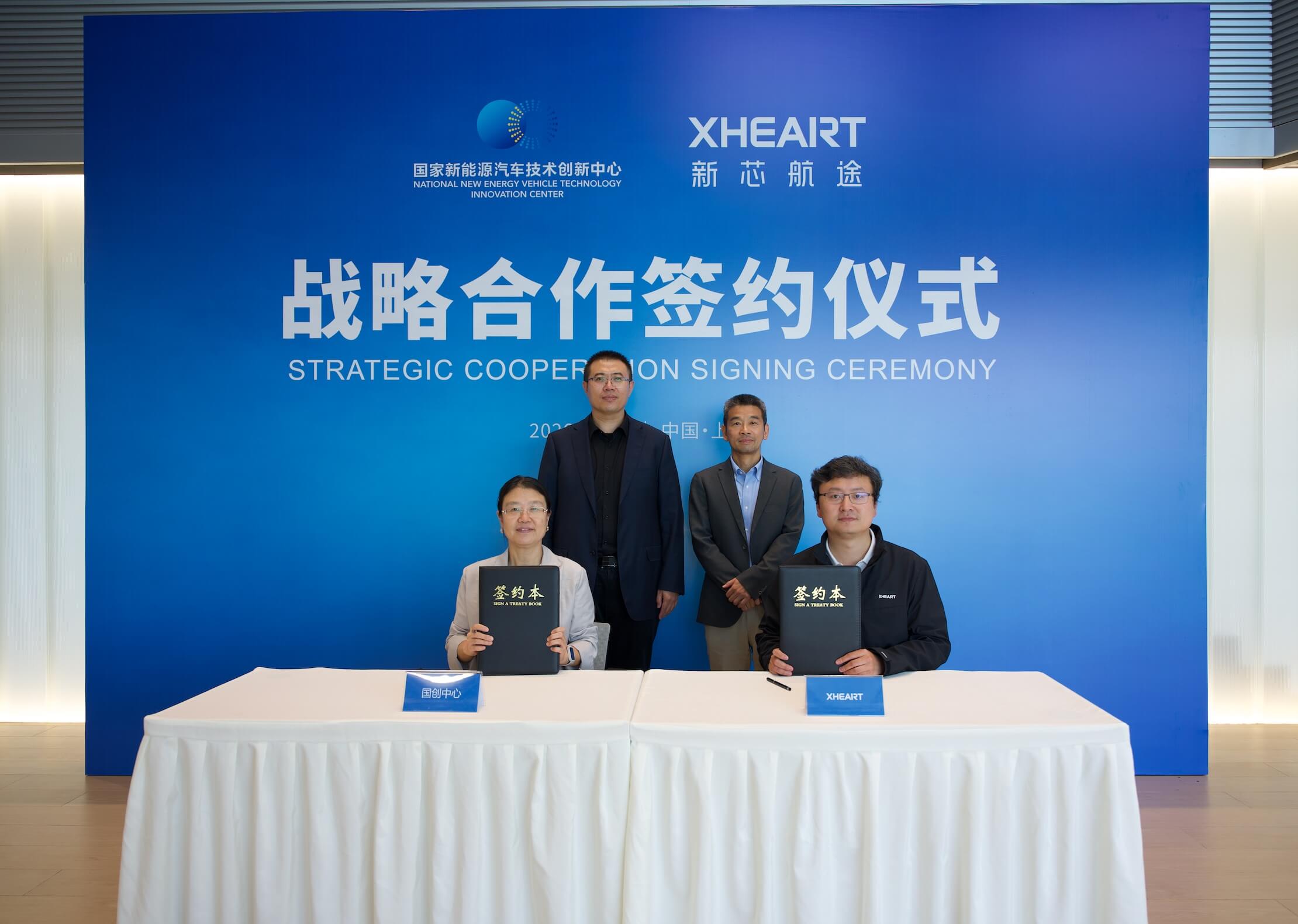
At the signing ceremony, Ying Liu, head of automotive chip testing and certification at the NEV Innovation Center, and Yubo Wang, XHEART's Senior Director of Product and Marketing, signed the agreement on behalf of their organizations. NEV Innovation Center General Manager Guangcai Zou and XHEART CEO Zonglin Li witnessed the signing.
As large models are deployed in vehicles more rapidly, actual chip performance needs to be assessed in light of the combined effects of the model, compute architecture and software toolchain. Measuring effective computing performance in real applications is a challenge shared across the industry. This collaboration will combine XHEART's experience in large-model chip design, hardware and software co-design, and mass-production deployment with the center's capabilities in standards research, testing and evaluation. Following a “standards first, validation in practice” approach, the two parties will focus on three areas.
Building a standards framework: The two parties will jointly research and participate in automotive chip standardization. They will develop association standards, contribute to national and industry standards, and turn industry practice into common methods to support China's automotive chip standards framework.
Validating and applying standards: The two parties will establish a joint strategic cooperation committee. They will study evaluation methods for chip functions and real-world use cases across performance, reliability, functional safety, information security, failure analysis and quality management systems. Practical validation will guide continued improvements, support broader industry adoption and establish a regular technical exchange mechanism.
Exploring advanced verification technologies: The two parties will jointly research emerging automotive chip verification technologies and, on a mutually beneficial basis, apply together for national, local-government and industry projects to provide technical support for the continued development of standards.
Established in 2018 under the designation of China's Ministry of Science and Technology, the NEV Innovation Center is the automotive industry's first national-level technology innovation center. In automotive chips, it connects upstream chip development with downstream vehicle applications through standards research, testing, evaluation, certification and quality management.
NEV Innovation Center General Manager Guangcai Zou said: “The industry needs effective evaluation standards built on broad consensus, so that upstream and downstream companies can communicate and select solutions using a common basis, reducing the cost of cooperation. We hope to distill shared experience from industry practice into standards that the whole industry can use.”
Founded in 2023, XHEART focuses on large-model computing. Guided by the principle of “model-defined chips,” it develops dedicated computing architectures with high performance and energy efficiency. Its chips are in mass production and used in several intelligent vehicles, with applications expanding into robotics. The X7 series has passed AEC-Q100 reliability verification. The company continues to strengthen its functional safety capabilities and is working with Momenta and QNX on safety solutions for global markets to support production delivery.
XHEART CEO Zonglin Li said: “In the era of large models, the value of a chip must ultimately be demonstrated in real applications. Together with the NEV Innovation Center, we hope to help the industry establish rigorous and effective evaluation standards, giving R&D teams a clear direction and buyers a sound basis for selection, and accelerating the use of large-model chips at scale.”